5.0
808+ Reviews
If you have been researching dental implants and been told that your jaw does not have enough bone to support them, you will know the particular frustration of that conversation. You arrived hoping for a solution, and you left with what felt like a door closing. The phrase “you are not a candidate” can sound very final — and for many patients, it is the point at which they resign themselves to a life of dentures or simply stop asking.
At Woodborough House Dental Practice in Reading, that conversation has a different ending. The team actively treats patients who have been declined for implants elsewhere, using advanced surgical techniques and a collaborative approach that most general dental practices simply do not have access to. Where others see obstacles, this team sees an assessment and a plan.
Why Bone Loss Happens — and Why It Complicates Implants
Bone loss in the jaw is not a sign of personal failure; it is a predictable biological consequence of tooth loss. When a tooth is extracted or falls out, the bone that previously surrounded and supported its root begins to resorb — to diminish — because it is no longer receiving the stimulation it needs. The longer a tooth has been absent, the more significant this bone loss typically becomes.
Other factors that contribute to bone loss include:
- Periodontal (gum) disease, which causes direct destruction of the bone supporting the teeth
- Long-term denture wear, which accelerates bone resorption because the denture sits on top of the gum rather than stimulating the bone
- Previous infections or cysts that have damaged bone structure
- Natural anatomical factors, such as a low sinus floor in the upper jaw
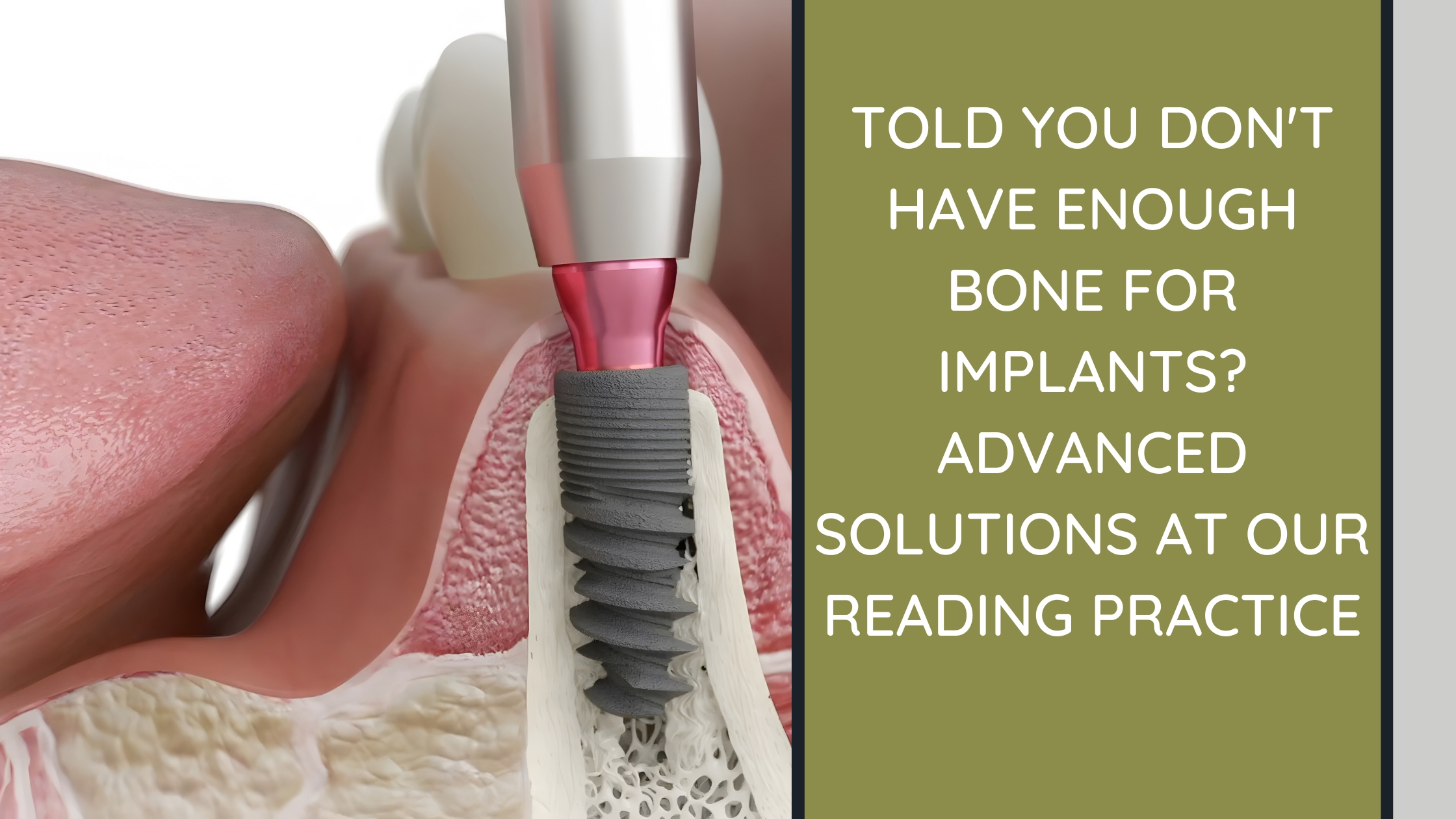
For dental implants to be placed conventionally, sufficient bone volume is needed to anchor the titanium fixture securely and allow osseointegration to take place. When that bone is insufficient, standard implant placement is not appropriate. But that does not mean implants are impossible — it means a different approach is required.
Advanced Solution 1: Bone Grafting and Sinus Lifts
For patients who lack the bone volume for implant placement but whose anatomy is otherwise suitable, bone grafting can rebuild the missing foundation before the implant is placed. A bone graft involves placing bone material — sourced from the patient, a donor, or a synthetic substitute — at the deficient site, where it gradually integrates with the existing bone over several months and creates a stable platform for the implant.
In the upper jaw, the sinus cavity often extends downward in areas where teeth have been lost, leaving insufficient bone height below it. A sinus lift procedure raises the sinus membrane and places bone graft material beneath it, increasing the available bone height for implant placement. This is one of the most commonly performed pre-implant procedures and, in experienced hands, has an excellent track record.
At Woodborough House, the gum and bone architecture around any potential implant site is assessed and managed in coordination with Dr Kuljeet Mehta, a GDC Registered Specialist in Periodontics. Dr Mehta’s role in the broader implant team is critical: ensuring that the periodontal environment — the gums and underlying bone — is healthy, stable, and optimised before any implant surgery takes place. A beautiful implant placed in a compromised periodontal environment is a clinical risk. Ensuring that foundation is sound is the work of a specialist periodontist.
Advanced Solution 2: Zygomatic Implants — For Severely Compromised Upper Jaws
For patients with severe bone loss in the upper jaw, where bone grafting alone would be insufficient or impractical, Zygomatic implants offer a profoundly different solution. Rather than anchoring in the maxillary (upper jaw) bone — which is deficient — Zygomatic implants are significantly longer and are anchored in the zygomatic bone, the dense cheekbone structure that is unaffected by jaw bone loss.
This technique means that patients who have been told they have “no bone” and are therefore not candidates for conventional implants can still receive a fixed implant-supported restoration without the need for extensive grafting. Dr Dipesh Kothari has particular experience in this advanced technique, which represents a meaningful lifeline for patients who had given up on the possibility of having fixed teeth again.
Zygomatic implants are not the right solution for every patient — they require careful anatomical assessment and are reserved for cases of severe upper jaw bone loss. But for those patients, they are genuinely transformative.
dental implants for bone loss Reading: The All-on-4 / Teeth in a Day Approach
For patients who are missing most or all of their teeth in one or both arches, the All-on-4 technique offers a way to restore a full arch of fixed teeth using just four implants — strategically angled to maximise the available bone without requiring the quantity needed for multiple individual implants.
The angled placement of the posterior implants in All-on-4 is specifically designed to avoid areas of deficient bone while still achieving excellent primary stability. In suitable cases, a provisional set of fixed teeth can be attached on the same day as surgery — the “Teeth in a Day” protocol — meaning patients leave the practice with a functional smile rather than a gap.
Dr Kothari assesses each patient’s suitability for the All-on-4 approach through CBCT scanning, which provides the three-dimensional bone mapping needed to plan implant angles and positions with precision. Not every patient is suitable for immediate loading, and transparency about this is a core value at Woodborough House — the goal is a successful long-term outcome, not a compelling headline.
The Importance of Getting the Assessment Right
One of the most important things patients who have been refused implants elsewhere can do is to seek a second opinion supported by the right technology. At Woodborough House, every implant assessment begins with a CBCT scan, which provides a level of detail that two-dimensional X-rays simply cannot offer. It is not uncommon for patients who have been told there is insufficient bone on the basis of a standard X-ray to have more options available than they were initially led to believe.
The multi-specialist collaboration between Dr Kothari, Dr Mehta, and Dr Nick Fahey — who leads the restorative phase as GDC Registered Specialist in Prosthodontics — means that every case is assessed from all clinical angles simultaneously. The question is never just “can we place an implant?” but “how do we achieve the best possible long-term outcome for this specific patient?”
A Practice That Does Not Give Up
The ethos that runs through implant care at Woodborough House is perhaps best summarised this way: the practice does not look for reasons to decline treatment. It looks for the most clinically sound pathway to a positive outcome, however complex the starting point. Patients who have been refused treatment elsewhere and who come to Woodborough House for a second opinion frequently discover that there are options they were never told about.
Being told you are not a candidate by one practice does not make that verdict universal. It makes it the starting point for a better conversation.
Get in Touch!
Don’t give up on your smile. If you’ve been told you can’t have implants, get a second opinion from our team at Woodborough House in Reading. Visit woodboroughhouse.com to book your consultation today.
You’ve Waited Long Enough
Get in touch with us to learn about award-winning, specialist-led cosmetic, restorative and general services at Reading’s home of slow dentistry.
Get in touch